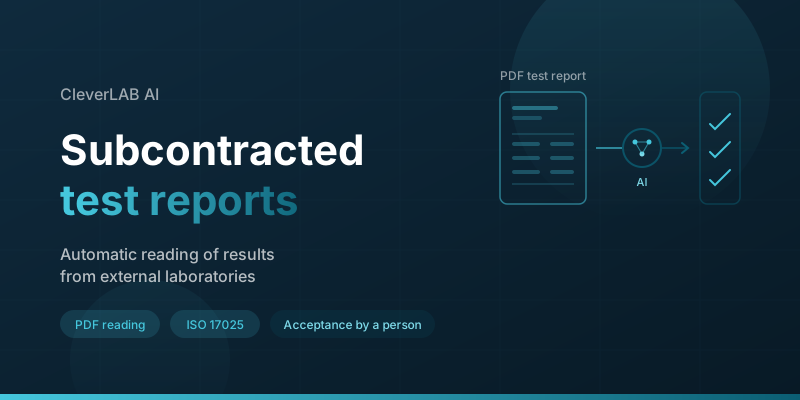
Why subcontracted test reports in particular
Almost no laboratory has everything its clients ask for in its scope of accreditation. Heavy metals, PAHs, Legionella, determinations to a different standard, seasonal tests performed once a quarter — all of this goes to a subcontractor laboratory. The client receives one test report, and you are responsible for everything in it.
And this is where a problem begins that does not show up in any efficiency report: the subcontractor sends back a PDF, and someone on your side retypes the numbers from it. Usually it is the person who already has the most other work — the technical manager or the person authorising test reports. Retyping takes from a few to a dozen or so minutes per document, it is tedious and it requires one hundred per cent attention. The perfect combination for making a mistake.
This article describes one narrowly defined use case of AI: reading the results from a subcontractor’s test report and placing them under the order items. No vision of an autonomous laboratory, no promises of a “revolution”. One task that a machine performs faster and more carefully than a tired person — provided that the decision to approve stays with a person.
Five errors that recur most often
- Comma versus point. A test report from a foreign laboratory gives 0.05, the system expects 0,05 — with careless pasting, the result can grow a thousandfold.
- mg/l instead of µg/l. The most costly error in environmental testing. The subcontractor reports micrograms, your scope works in milligrams — without conversion, a compliant result becomes an exceedance.
- A shifted row. A table with fifteen determinations, the eye slips by one line and the chromium result lands next to nickel.
- A lost less-than sign. < 0.5 retyped as 0.5 is no longer “below the limit of quantification” but a specific measured value. It changes the interpretation and the conformity assessment.
- A missed footnote. A note about a deviation from the method, about the sample being taken by the client, or that a given determination is outside the subcontractor’s scope of accreditation — usually small print at the bottom of the page, yet it must go into the final test report.
Why the auditor asks about this first
When subcontracting tests, the laboratory must demonstrate control over the external provider (clause 6.6 of ISO/IEC 17025) and clearly identify in the test report the results obtained from that provider (clause 7.8.2.1 p)). Manually retyping numbers from someone else’s PDF usually loses both: the mark of origin disappears, and the link to the original lives only in the memory of the person who did it.
The use case step by step
Below is the full path of one document — from its arrival to the moment the result is ready for the final test report. The whole sequence takes about as long as reading this paragraph; the last step is the only place where a person is needed.
What the model must read for the result to be complete
The number alone is not enough. The final test report for the client must carry much more information, and all of it is in the subcontractor’s document — just scattered across three different places. The minimum set without which the entry makes no sense:
- Who tested — the full name and address of the subcontractor laboratory and its accreditation number.
- The number and date of the subcontractor’s test report — the identifier by which the auditor will reconstruct the link.
- Sample identification on both sides — your sample designation and the designation given to it by the subcontractor.
- The dates of sample receipt and of testing — without them you cannot assess whether the sample holding time was met.
- Determination, result and unit — together, never separately.
- The test method with the year of the standard’s edition — “EN ISO 17294-2” without a year is a different method than with one.
- Expanded uncertainty and coverage factor — if the subcontractor stated them.
- The limit of quantification and how results below it are reported.
- Remarks, deviations and statements of conformity — including which determinations were outside the scope of accreditation.
A rule without exceptions
If any of this information is missing from the document, the model must not fill it in — it must report the gap. Guessing the year of a standard or adding a unit “because that is how it usually is” is exactly the kind of help that makes a tool unfit for an accredited laboratory.
Where it breaks down
An honest description of a use case must include the situations in which the automation cannot cope. There are several, and all of them are predictable:
- A poor-quality scan. A faxed document, one photographed at an angle, or signed in pen across the table. The reading is then uncertain and must be marked as requiring a full check.
- A table broken across pages. The column headers stay on the first page, some rows land on the second — without recognising the continuation it is easy to assign values to the wrong columns.
- Repeats and dilutions. The same determination appears twice in the test report because the test was repeated. Only a person knows which result is the right one — and that person must indicate it.
- A combined test report for many samples. One document, ten samples in columns. The risk of assigning a result to the wrong sample is highest here.
- Names that look alike. “Chromium” and “Chromium(VI)” are two different determinations with different limits. Pairing by name alone is unacceptable here — matching together with the method is necessary.
The overriding rule: AI proposes, a person authorises. A tool that saves results without confirmation shifts responsibility for the test report to the software vendor — something no standard provides for and no auditor will accept. The value of this use case is not removing the person from the process, but turning their work from retyping into checking.
Audit trail
Automatic reading makes sense only if you can later reconstruct where every number came from. That is why a complete set of information about the reading itself is saved with every accepted result — regardless of the original document already being attached to the order.
| What is saved | What for |
|---|---|
| Source document | The subcontractor’s original test report in the form in which it arrived — without conversion or processing. |
| Date and time of reading | Places the reading in the sequence of events relative to the receipt of the document and the authorisation of the test report. |
| Model version | When the tool changes its behaviour, you know which earlier readings were made with the old version. |
| Proposed value | Saved next to the approved value — you can see whether the person corrected anything and what exactly. |
| Accepting person | Named responsibility for entering the result into the order. |
| Subcontracting mark | Permanently tied to the result, carried over to the final test report and fulfilling the requirement of clause 7.8.2.1 p). |
The last row of the table is the most important one here. A subcontracting mark assigned automatically at the moment of reading cannot be forgotten, because nobody types it in — it follows from where the document came from. It is the only change in the whole process that improves compliance with the standard by its very design, rather than through the team’s discipline.
What it really brings
The figures below are a worked example, not the result of a measurement at a specific client. Let us assume a medium-sized laboratory that subcontracts regularly, but not on a massive scale:
Four hours a month is not a figure worth selling as a breakthrough. The real benefit lies elsewhere: these are four hours of work of the most expensive person in the laboratory, done under deadline pressure, on a task where one careless row costs a complaint, a repeated test or a nonconformity at the audit. Replacing retyping with checking changes not so much the number of hours as the distribution of risk.
A side effect nobody plans
When all subcontractor test reports pass through one place, after a few months you have ready data for the supplier evaluation required by clause 6.6: who meets deadlines, who sends documents that need corrections, whose method descriptions keep missing information. Without keeping a separate register.
How to set it up in your laboratory
Implementing this use case does not require rebuilding the laboratory. It does, however, require the right order — trying to switch everything on at once ends with the team distrusting the tool:
- Choose one subcontractor — the one from whom you receive the most test reports with a repeatable layout. That is where you will see the effect fastest.
- Collect several dozen of their test reports from the past year and check the reading on documents whose results you already know. It is the only honest test: a comparison with what was actually entered by hand.
- Run in parallel for a month — automatic reading alongside the existing retyping. The differences that come up are more valuable than the matches.
- Describe it in the management system documentation — who accepts, what happens with an ambiguous reading, how subcontracted results are marked. The auditor will ask about the procedure, not the technology.
- Only then add further subcontractors — one at a time, checking each new test report template separately.
Does this mean that AI approves the results?
No. And this is the only answer under which this use case is fit for an accredited laboratory. The model performs a technical task — it transfers information from one document to another, more accurately than a person, because it does not get tired at the fifteenth row of a table. Conformity assessment, the decision to repeat a test and the authorisation of the test report remain tasks of the authorised person, exactly as before the implementation.
It is also worth saying what this tool does not do: it does not assess whether the subcontractor performed the test correctly, it does not replace control over the provider, and it does not release you from the obligation to check whether the determination was within its scope of accreditation. Reading a document and controlling a provider are two different matters — automating the first does not take care of the second.
Summary
Retyping results from other laboratories’ test reports is a task with all the features of a good candidate for automation: it is repetitive, time-consuming, performed by the busiest people and prone to errors with serious consequences. At the same time, it is narrow enough to be described, tested and documented — and therefore defended before an auditor.
A sensible implementation of AI in the laboratory looks exactly like this: one specific task, a clear boundary of responsibility, a full audit trail. Not an “intelligent laboratory”, just less retyping of numbers from a PDF at two in the afternoon.
If you want to see how this reading behaves on your subcontractors’ test reports, write to us — the best test is a dozen or so of your own documents.
Let’s test it on your test reports
We will show the reading on documents from your subcontractors and discuss how to describe this change in the management system documentation — so that it passes the audit.
Related articles

AI assistant in the laboratory
A broader look at artificial intelligence in laboratory work — from data analysis to pattern recognition.
LabCoda.pl — how to find a subcontractor
A search engine for accredited laboratories by scope of testing — the starting point when you are looking for someone to subcontract to.

LIMS compliance with ISO/IEC 17025
The standard’s requirements for the system — including control of external providers and the content of the test report.
Basis and sources
- PN-EN ISO/IEC 17025:2018-02 General requirements for the competence of testing and calibration laboratories — clause 6.6 (externally provided products and services) and clause 7.8.2.1 p) (clear identification in the test report of results obtained from external providers): iso.org/standard/66912.html.
- Polish Centre for Accreditation — documents and requirements for testing laboratories, including the rules for using external services: pca.gov.pl.
- European co-operation for Accreditation — interpretative material on reporting results according to clause 7.8 of the standard: european-accreditation.org.
- LabCoda.pl — a search engine for accredited laboratories by scope of testing: labcoda.pl.
About this article
The use case described concerns reading test reports from subcontractor laboratories. The times and numbers of test reports given are a worked example for a medium-sized laboratory — they show the order of magnitude and are not the result of a measurement at a specific client.
The CleverLAB team develops LIMS software for laboratories accredited to ISO/IEC 17025. Our clients include water, wastewater and microbiology laboratories, physico-chemical laboratories and technical cleanliness laboratories.